If you’re just starting out, don’t buy a pile of tools. Start with just a basic kit and add to it as needs arise.
Deals on Tools – check online buy/sell sites and companies specializing in estate sales. Often you can pickup good tools without paying a lot. If you’re serious about working on your own bike, here’s a good starting point:
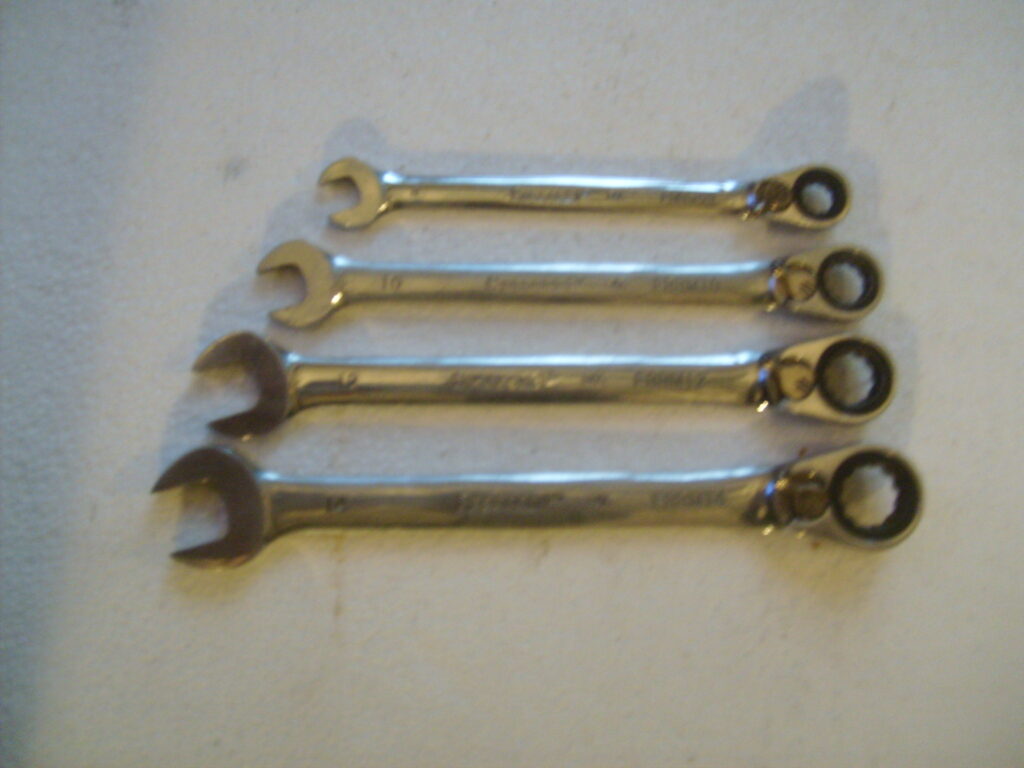
Wrenches – ratchetting ring end, open end combination type are awesome but remember if you have access to older non-ratcheting types at a good price, grab ’em.
Socket wrench set – generally all you need to start is a 3/8″ drive 6 point socket set with short and medium extensions. 6 point sockets are stronger and more versatile than 12 point. In time you’ll want shallow and deep reach sockets but to start, shallow is all you need.
Get a short handled ratchet driver that has 1/4″ drive on one side and 3/8″ drive on the other. I rarely use 1/4″ drive stuff but it’s an option.
A short ratchet is usually all you need. Over tightening is a common cause of stripped or broken bolts. I have an 18″ long 3/8″ ratchet with a swivel neck that’s very handy, like a breaker bar with the convenience of a ratchet. But I use it almost solely for tear down.
Torque wrench in inch/pounds is “nice to have”, certainly necessary if you have to actually tear into the motor, but otherwise it’s going to collect dust. Buy it when you need it.
Screwdriver set – good quality screw drivers are worth the cost. Use them carefully like any precision tool. If you “just need a flat blade to pry with” get some cheap tools specifically for that job.
Spring Loaded Impact Driver – this little impact, used with the mallet (item next) uses impact quality screwdriver tips, available in sets. You will use these to undo the screws holding engine side covers, etc.
Mallets – a 3 pound short handled mallet, like a mini-sledge is very handy as is a plastic tipped machinist hammer (double headed).
Pliers – needle nose about 4″ long, standard and a wire cutting/stripping/crimping tool. In time you’ll probably want inside and outside snap ring aka circlip pliers too.
Battery Charger, Electrical Multi Meter & Battery Tester with Load Simulation – The good news here is you do NOT need a high powered battery charger. ALL motorcycle batteries should be charged with a maximum of only 2 amps!
A multimeter is indispensable for testing circuits but the one thing it cannot do is give you good battery information.
A true battery tester is cheap and will allow you to view the battery volts as you simulate a starting load. Then you can view the voltage drop and subsequent recovery.
A motorcycle sized hydrometer is great for old type lead/acid batteries. These hydrometers look like a miniature turkey baster. A hydrometer tests the specific gravity of the acid and there’s a scale on the tool showing what’s a good charge level. The beauty of these things is, if you use a lead/acid battery, a hydrometer will identify a bad cell in a battery.
Small wire brushes the size of tooth brushes are very handy to clean screw heads before attempting to remove them, etc.
Camera – Whether you use a phone camera or other digital camera, it’s important to check your pictures as you go to ensure they are clear. Make a few notes referencing those photos so you know what they are about, months from now. Organize and store your picutres for easy reference.
Plastic tote, bags, wide masking tape & felt pens so you can literally tag and bag parts.
A few sturdy chemical tolerant wash buckets & wash brush and some cloth or shop towels will get lots of use.
Shop Vacuums – A good shop vac, even a small unit, is very helpful. Note that shop vacuums differ from household vacuums because the motor of a shop vac has cooling air flow separate from the main airflow of the vacuum. This allows a shop vac to be used to pick up liquids and be used for processes like vacuum bagging without damage to the motor. Of course, you should never use a shop vac for flammable liquids.
Air Compressor – You don’t NEED a big compressor for most repair work. If you get involved with media blasting and/or spray painting, you will then need a bigger unit. But one of the 150PSI “pancake” style compressors will serve you well for most work.
Keep your eyes open for extra tank storage. I was given a compressor/tank unit with broken compressor. I removed the broken compressor, used the motor for my buffing bench and put the tank to work as an extra reservoir.
This is just a starting point. It’s basically what I started with when I was a kid getting started in MX racing. Though experienced people will look at this and be tempted to say “you need this and that too!”, this will get you started. Buy more as the need arises.
RETURN TO PREVIOUS SITE LEVELS: